I've made a major update to my article on Running in the Cold. I've added sections on common mistakes, cold injuries and approaches to
staying warm.
Thursday, November 7, 2013

Sunday, November 3, 2013
Genetic Testing
I've published my genetic testing results from 23andme.com. Do
you think I have the genes of a sprinter? Find out at http://fellrnr.com/wiki/Genetic_Testing
Friday, November 1, 2013
Updated - The Accuracy of GPS Sports Watches
I've updated my analysis of GPS Accuracy to show the accuracy of different watches. I was a little surprised to see how much difference a footpod made to the accuracy of the 310XT.
Saturday, October 26, 2013
October Overload Taper
When I'm preparing for a big race I will often use an overload taper. This
approach uses a week long overload period of increased training stress before a
two-week reduction leading up to the race. The idea is that during the overload
week fatigue builds up cumulatively, and the two weeks of reduced training
allows for Supercompensation.
For the 2013 Croatan 24 hour race
I attempted to run 32 miles/day, ending up with a total of 200 miles. I thought I'd share some background and observations.
- In the week before the overload I ran four times totaling 106 miles. One of those runs was a treadmill descent at 12% decline covering 26 miles at 6:30 min/mile pace. This caused significant DOMS.
- At the start of the overload week I still had quite a bit of the DOMS remaining. However, even though I was running 32 miles a day, I found my legs were able to recover, and the DOMS disappeared midway through the overload week.
- Running 32 miles requires quite a bit of time, especially as fatigue slowed me up during the week. As a consequence I had to get up particularly only which reduced my sleep time.
- I also found my sleep quality became increasingly impaired as the week progressed. Initially this was a reduction in REM sleep, something I've found, and with increased training. However, as the week progressed I also found it harder to fall asleep due to muscular pain. By the end sleep deprivation had become an issue.
- Because I was getting up so early a lot of my run was in the dark, something that is psychologically tough. I found my mood always improved with the dawn.
- While the DOMS disappeared during the week, it was replaced by significant, pervasive muscular soreness. Extensive use of massage helped keep my legs working, but eventually the situation became untenable. It was interesting to observe on Saturday after a 24 mile run, my legs did not feel tired, just sore.
- Given the level of sleep deprivation and fatigue I was surprised that my mood state remained much better than I would've expected. I suspect that this is a benefit of my ketogenic diet.
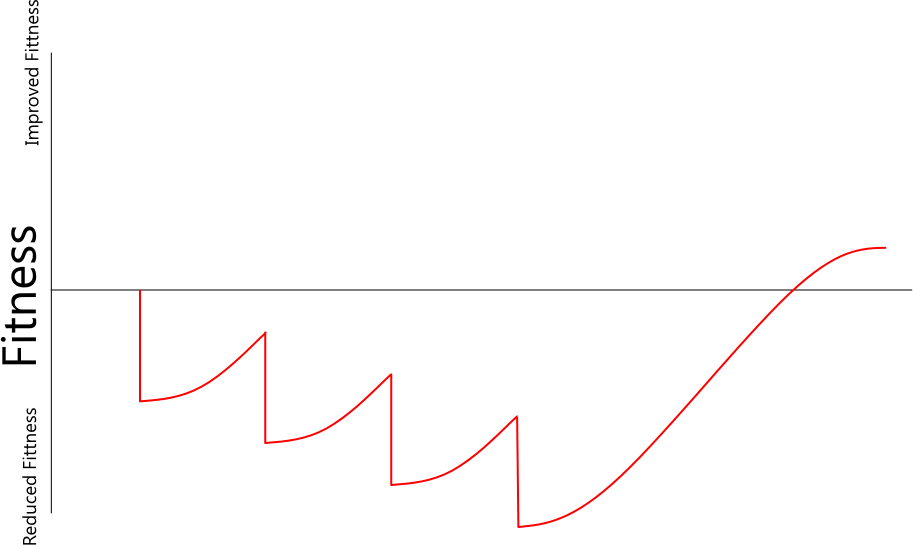
- The graph below (from Supercompensation and Overload) seems
remarkably appropriate for this week. As the fatigue increased, my effective
fitness steadily went down. By the end of the week is a 9:00 min/mile pace
seemed quite fast. My personal interpretation is that the fatigue is exhausting
the muscle fibers that are normally recruited first, so the muscle recruitment
pattern is changing to use secondary fibers. My hope is that this fatigue helps
train and adapt these secondary fibers.
- By day 6 (Saturday) my legs were too painful to finish the 32 miles, and I quit after 24. I thought the week was over, as it was painful to walk after I’d finished the run. Strangely, my legs did not seem tired in the usual sense, just damaged. I resorted to some particularly deep massage on my quads, using my elbow to dig into the Vastus intermedius muscle and the adductors. This massage, combined with an hour’s sleep in the afternoon and some extra calories and I felt surprisingly good.
- I decided to run again on Sunday and my legs felt strong, with the pain in my quads not returning until about 10 miles. I was able to keep up a 8:15 min/mile pace, which was not bad given the preceding week. I stopped after 16 miles, as this rounded things out to 200 miles for the week.
- I did try to keep using my DIY altitude training system during this overload week, but it was too much. I found that the hypoxia was too tiring and I dropped it after a couple of days.
Thursday, October 24, 2013
Updated recommendations for best running watch
I've updated my recommendations for best running watch,
adding in the Garmin 10 as a recommendation and the Polar RC3 as worth
considering.
Wednesday, October 23, 2013
GPS Accuracy - Even GPS watches have bad days
Did you know that even GPS watches have bad days? That’s why
you can’t compare GPS accuracy on the basis of a single run. Luckily, I
recorded runs with two GPS watches, and happened to get data to illustrate the
problem nicely. http://fellrnr.com/wiki/GPS_Accuracy#Even_GPS_Watches_have_Bad_Days
Subscribe to:
Posts (Atom)

 Posts
Posts


